
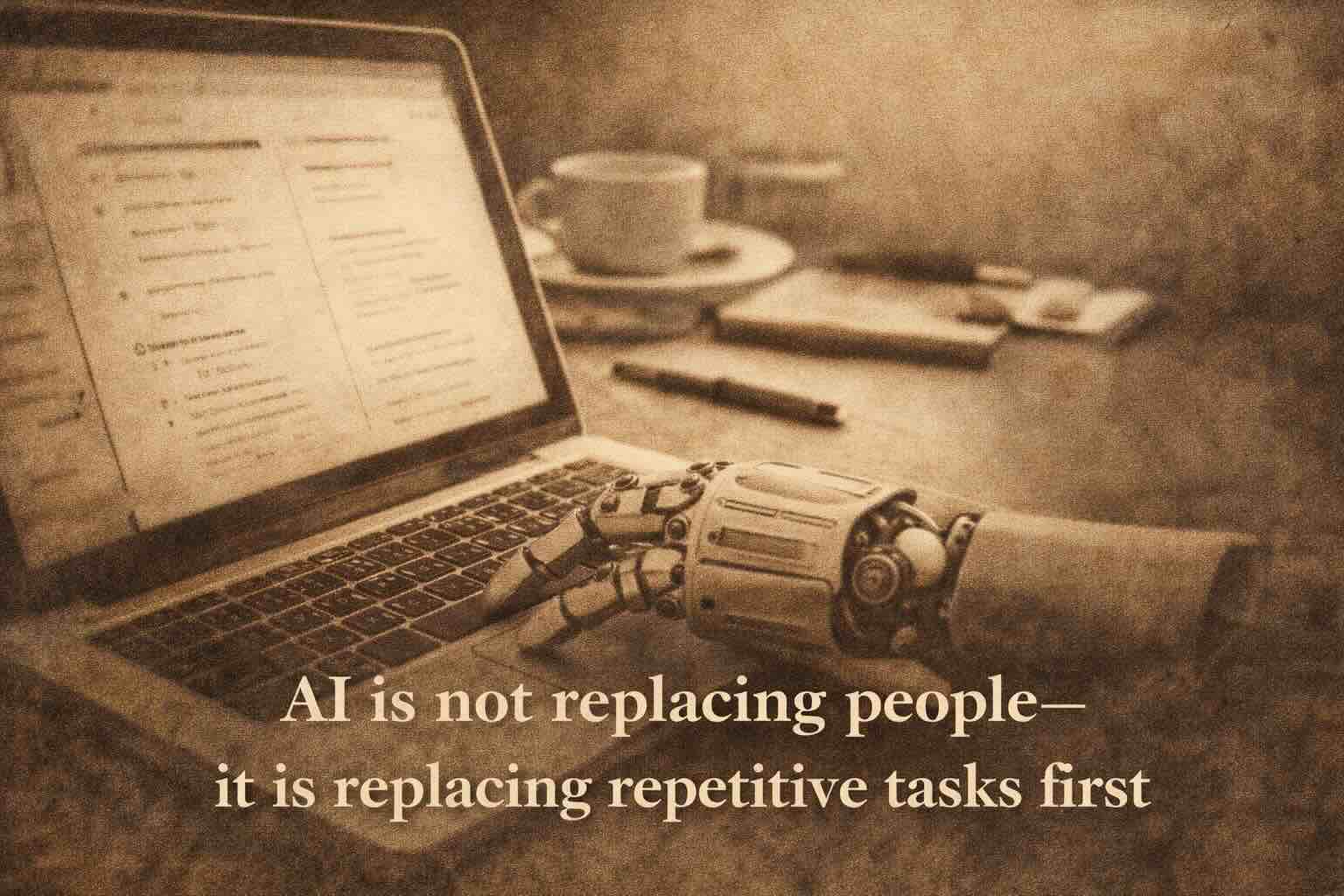
The loudest AI conversation is: “Will it take my job?”
The more accurate conversation is: “Which tasks in my job are predictable enough to automate?”
AI is already changing work, but not the way science fiction promised. It is not a single robot taking a role. It is a set of tools quietly removing the repetitive parts of many roles.
That shift is less dramatic, but far more widespread.
What AI does well (right now)
AI is strongest at tasks that look like this:
- summarising text (meetings, emails, documents)
- drafting first versions (messages, reports, outlines)
- classifying and sorting (tickets, leads, feedback)
- searching and extracting (finding answers in a knowledge base)
- transforming formats (notes → email, transcript → bullets)
- pattern-based assistance (basic analysis, simple automations)
If you do any of these daily, you can probably save hours a week.
Where AI still fails (and why it matters)
AI struggles when:
- the stakes are high and mistakes are costly
- the task needs fresh, verified facts
- the answer requires deep context about your company or situation
- the output must be legally precise or ethically sensitive
- the truth cannot be inferred from patterns
That is why “human-in-the-loop” is not a slogan. It is the difference between useful and risky.
The real skill: workflow, not prompts
Most people think the advantage is writing clever prompts.
The advantage is designing a workflow:
- define the task clearly
- provide the right input (context + constraints)
- generate a draft
- verify important facts
- publish or execute
If you skip verification, you get speed but lose trust. If you verify well, you get speed and quality.
Simple examples that actually work
- Meetings: record → transcript → summary + decisions + action items
- Customer support: classify tickets → suggest reply draft → agent approves
- Sales: call notes → follow-up email draft → CRM update suggestion
- Content: topic → outline → first draft → editor improves + adds sources
- Operations: repetitive emails → templates → small automations
This is not futuristic. It is operational. The companies adopting it early are not necessarily “more technical”. They are more systematic.
How to adopt AI without making a mess
If you are an individual or a small team, start with one rule:
Automate low-risk tasks first.
Examples: drafts, summaries, formatting, internal notes.
Then add guardrails:
- a checklist for verification
- clear disclaimers for internal drafts
- a “no AI” list for sensitive content
- version control so mistakes can be traced
The next shift: AI agents (and why people are cautious)
You will hear more about “AI agents” — tools that can take actions (not just generate text), like booking meetings, updating systems, or executing workflows.
This is powerful, but it increases risk. Once a system can act, errors matter more.
The best adoption path is staged:
- start with suggestions
- move to assisted actions
- then to limited automation
- only then to broader autonomy
Next step: If you tell me what your company sells (or what workflows you want), I can map the best programmatic SEO clusters for your product: use cases, integrations, industries, templates, comparisons — the pages that convert.
Leave a Reply